Travis · Williamson · Hays · Bastrop
Austin EV Charger Installers: Level 2 Charging, Panel Upgrades & Standby Generators Across Central Texas
Installed to the standard the rebate requires, from the central bungalows to the rock west of the lake. We establish which utility serves you and what is under the cable path before we quote — not after.
Request a quote
The car, where it parks, and the address. That last one tells us who supplies your power and what the cable has to cross.
That is with us. We will look at what you have sent and come back to you shortly.
Need an answer sooner? Call (737) 330-0611.
That did not go through. Nothing has been lost from the form, so another attempt should work.
Or call (737) 330-0611 and we will take them over the phone.
- Austin Energy rebate
- 50% to $1,200
- Your install
- After load calc
- Utilities here
- 6
- Protected tree
- 19 in.
- 31
- Cities covered
- Travis, Williamson, Hays and Bastrop
- 6
- Utility territories
- Two municipals, three co-ops, one TDU
- 12
- Services
- Charging, panels, backup power
- Every job
- Permitted and inspected
- The condition Austin Energy attaches to its rebate
What we install
All 12 of them — the charging equipment, the electrical work standing behind it, and somewhere to draw power from when ERCOT has a bad week.
Charging 4
Level 2 EV Charger Installation
A 240-volt circuit and a mounted charger, so the car fills overnight instead of over most of a week. The work that decides the price happens before the drill comes out.
If Austin Energy supplies you, the rebate pays half of this back — but only against a permitted install by a licensed electrician. That is worth more than any discount an unlicensed installer can offer.
Read moreHardwired EV Charger Installation
The charger wired directly to the circuit. Higher amperage, one less connection to fail, and the option that suits an outdoor position in this climate.
If the charger is going outside, or the car is a full-size truck that will draw the maximum for hours, hardwiring is the version that lasts.
Read moreTesla Wall Connector Installation
Wall Connector installation, including the load-sharing setups that let two cars share one circuit — common here, where a second EV in the driveway is unremarkable.
Two cars do not automatically mean two circuits. Power sharing often fits a second connector onto a service that could not otherwise take one, and it is cheaper than growing the panel.
Read moreNEMA 14-50 Outlet Installation
A 240-volt receptacle for a plug-in charger. Cheaper up front than hardwiring, with a trade-off worth understanding before you choose it.
A receptacle lets you take the charger with you, which matters if you are renting or expect to move. A hardwired unit is the better long-term install. We will tell you which fits your situation rather than which is quicker to fit.
Read moreElectrical 1
Backup Power 3
Home Battery Backup Installation
Storage that carries the house through an outage. February 2021 made this a mainstream request in Central Texas rather than a niche one.
Backing up the whole house is the expensive way to do this. Backing up the circuits that actually matter — fridge, a few outlets, one HVAC zone — costs a fraction and covers the scenario people are really worried about.
Read moreStandby Generator Installation
A permanently installed generator with automatic transfer. The option that does not care how long the outage lasts.
Batteries are quieter and need no fuel. Generators do not run out after a day. On acreage west of the city, where restoration takes longest, that difference is usually the deciding one.
Read moreBidirectional Charging & Vehicle-to-Home
Using the car's pack to carry the house. A large truck battery holds considerably more than a typical home storage unit, and it is already in the driveway.
This is genuinely promising and genuinely immature. We will tell you plainly whether your vehicle and your utility support it today, rather than selling you a system that waits for a firmware update.
Read moreService 2
EV Charger Repair & Maintenance
Diagnosis when a charger stops, faults intermittently, or throttles. Frequently the circuit rather than the unit — and in this climate, frequently heat.
A charger that worked for two summers and now trips is rarely a dead charger. It is usually a termination that has been through enough heat cycles to loosen.
Read moreEV Charger Relocation
Moving an existing charger — a new house, a rebuilt garage, or a second car that has made the original position wrong.
Taking the charger with you when you move is usually worth doing, provided the unit is not so old that the replacement has caught up. We will tell you which case you are in.
Read moreCommercial 2
Commercial EV Charger Installation
Workplace, retail and multi-family charging — from a couple of ports to a staged build-out with the conduit laid for what comes next.
The expensive mistake is trenching for today's port count. Laying conduit for the full build-out costs comparatively little while the lot is already open.
Read moreDC Fast Charger Installation
High-power public and fleet charging. A different class of project — this one starts as an electrical service question, not a charger question.
The first question is not which charger. It is whether the site's service can carry it, and what the utility would require to get it there. We start there, because that answer decides whether the rest is worth costing.
Read moreTwo unknowns, settled first
What decides your price is underground
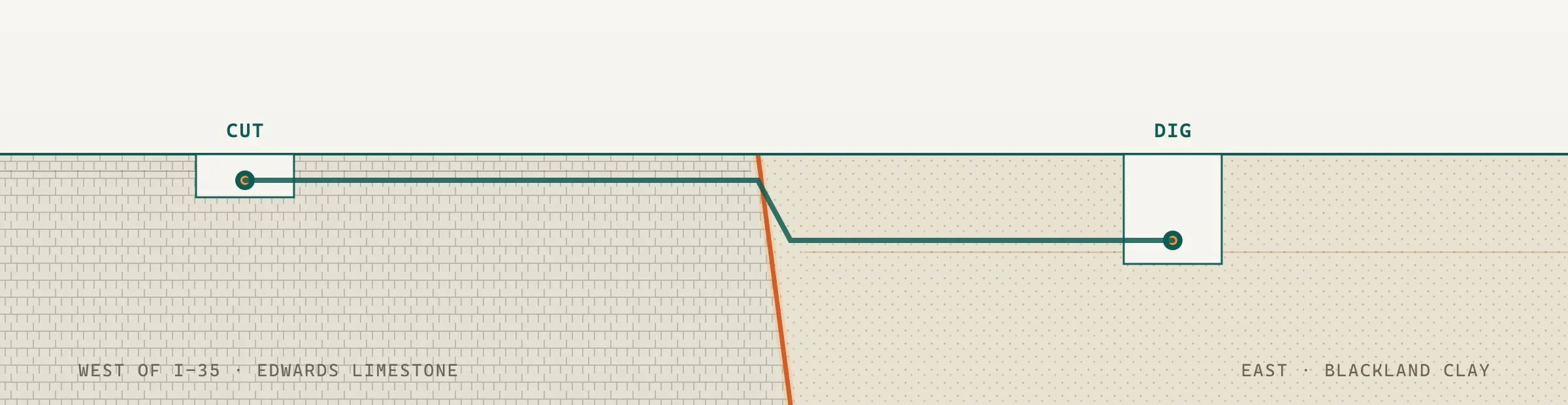
Two things move the number on an Austin quote, and neither is visible from the street. The first is inside the panel. The second is under the lawn: west of I-35 the limestone starts within inches of the surface, and a run that takes an afternoon in Hutto takes considerably longer in Lakeway.
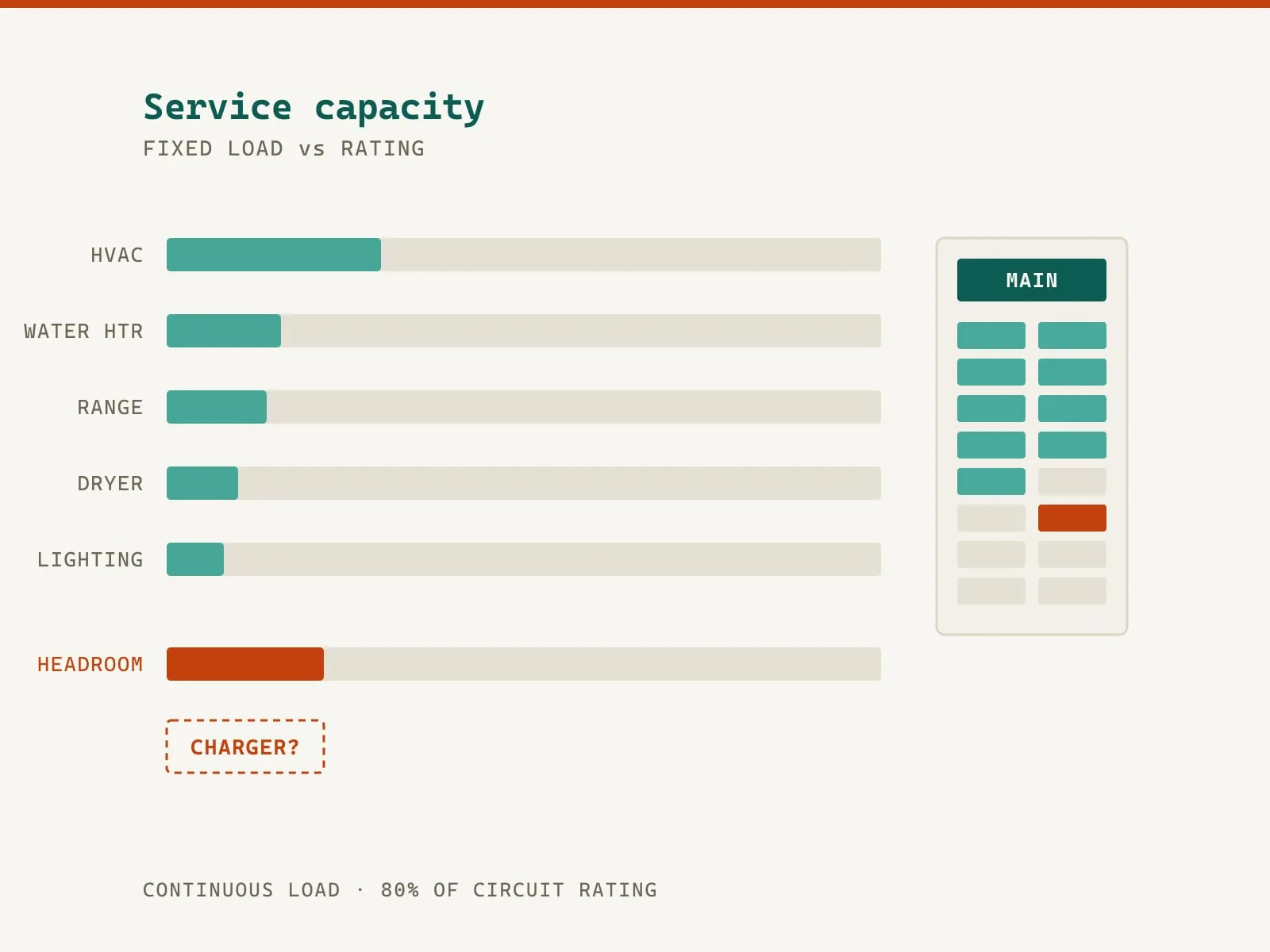
The panel question has a definite answer. Totalling the fixed loads against the service rating shows exactly what headroom remains, and that produces one of three outcomes: a straightforward circuit, a circuit plus load management, or a service that genuinely has to grow. They are three different jobs at three different prices.
The route question needs eyes on the property — where the rock starts, what the canopy protects, how far the car parks from the panel. We would rather spend twenty minutes establishing both than send a number that changes on the day.
- Continuous load rule
- 80%
- of circuit rating
- 48A charger needs
- 60A
- circuit, not 50A
Chargers we install, by what you drive
26 makes, one set of electrical work. What you drive changes the connector on the end of the cable and very little else — the load calculation, the circuit, the conduit run and the permit are indifferent to the badge. Worth saying plainly in a metro where the cars are assembled locally and brand loyalty runs hot.
- Tesla
- Model 3 · Model Y · Cybertruck
- Rivian
- R1T · R1S · R2
- Hyundai
- Ioniq 5 · Ioniq 6 · Kona Electric
- Kia
- EV6 · EV9 · Niro EV
- Ford
- F-150 Lightning · Mustang Mach-E · E-Transit
- BMW
- i4 · iX · i5
- Polestar
- Polestar 2 · Polestar 3
- Volvo
- EX30 · EX90
- Audi
- Q4 e-tron · Q6 e-tron · e-tron GT
- Mercedes-Benz
- EQB · EQE · EQS
- Volkswagen
- ID.4 · ID. Buzz
- Lucid
- Air · Gravity
- Porsche
- Taycan · Macan Electric
- Chevrolet
- Equinox EV · Blazer EV · Silverado EV
- Cadillac
- Lyriq · Optiq · Escalade IQ
- GMC
- Hummer EV · Sierra EV
- Nissan
- Ariya · Leaf
- Toyota
- bZ4X
- Lexus
- RZ
- Genesis
- GV60 · GV70 Electrified
- Subaru
- Solterra
- Honda
- Prologue
- Acura
- ZDX
- MINI
- Cooper SE · Countryman Electric
- Jeep
- Wagoneer S · Recon
- VinFast
- VF 8 · VF 9
Something not on the list? It is still a 240-volt circuit and somewhere to hang the unit. Call (737) 330-0611.
Which plug do you need?
Two AC standards are in circulation while the industry finishes changing over. The year on the registration decides which one you have, not the badge — the same nameplate can differ between a 2024 and a 2026.
NACS
SAE J3400The connector Tesla built and the rest of the industry adopted. It is disproportionately common here — the cars are assembled in Travis County and the local fleet skews newer than the state as a whole — so on this side of the metro it is the default assumption rather than the exception.
J1772
SAE J1772What almost everything that is not a Tesla shipped with until recently, and still the majority of used inventory in Central Texas. It is not going obsolete: adapters run in both directions, and a charger bought today will outlast the argument.
At home, the standards question is smaller than the internet suggests. Both deliver identical power over an identical circuit, and adapters work in both directions, so the choice governs which cable hangs on the wall. It has no bearing on the panel, the trench or the inspection. A quote that moves because of the marque is pricing something other than the wiring.
Marque and model names above are the trademarks of their owners and appear here only to identify the vehicles this equipment gets fitted for. We are an independent electrical contractor with no affiliation to, endorsement from, or certification by any vehicle manufacturer.
Charging questions, answered for Central Texas47 answers
The questions that actually come up here — rebates, permit offices, panel headroom, rock, and which utility you are on.
Start here
Can I get the Austin Energy rebate for a home charger?
If Austin Energy is your utility, yes — the programme pays half the cost of the equipment and the installation, capped higher for an OCPP-compatible unit than for a plain Level 2, one rebate per vehicle. Two conditions decide it: the work has to be done by a licensed electrician, and a City of Austin electrical permit has to be pulled and inspected. An unpermitted install by an unlicensed installer is not a cheaper install. It forfeits the rebate.
How do I know whether Austin Energy actually serves me?
Read the top of your electricity bill. Six providers serve the cities we cover — Austin Energy, Pedernales, Bluebonnet, Oncor, Georgetown Utility Systems and San Marcos Electric — and the boundaries follow service territory rather than city limits, so a Cedar Park or Pflugerville address tells you nothing on its own. Your bill is the definitive test, and the answer changes what rebate you can claim and how a service upgrade gets requested.
Why is a trench so much more expensive on the west side of town?
Because of what is under the grass. West of I-35 the Balcones Fault puts Edwards limestone within inches of the surface, so a run to a detached garage needs a rock saw or a hammer attachment rather than a trencher. East of I-35 the same run goes through Blackland clay and is routine. It is the single largest swing in what an otherwise identical job costs across this metro.
Do the tree rules affect where my charger can go?
They can, and this catches people out. A trunk of 19 inches or more is a protected heritage tree, and its critical root zone extends one foot for every inch of that diameter — so a two-foot trunk protects a circle 24 feet across. Trenching that significantly disturbs that zone needs review even when the tree stays. On the older central lots, where the only sensible conduit path runs down an alley under mature canopy, this decides the route.
What will an installation cost?
The honest answer is that it is quoted after a load calculation and a look at the run, because the two things that move the number most are invisible from the street: whether your panel has capacity left, and whether the cable path crosses rock. We would rather give you a real figure after twenty minutes on site than a number now that changes when we arrive.
Do you handle makes other than Tesla?
Every make sold here. The electrical work is the same regardless of the badge — the circuit, the load calculation, the conduit and the permit do not care what is parked in front of them. What differs is the plug on the end of the cable, and adapters cross between the two standards in both directions. Tesla density is unusually high in this metro because the cars are built in Travis County, but that changes the hardware conversation, not the wiring.
Is the federal tax credit still available for home charging?
No. The federal 30C credit ended on 30 June 2026 and a lot of charger pages have not caught up. Local programmes are what remain, and they depend entirely on who supplies your power — which is another reason the bill in your kitchen drawer is the first thing worth checking.
How long does the job take?
Where the panel already has room and the run is short, a single visit. Three things stretch it: a service upgrade, which brings your utility into the schedule; rock, which turns an afternoon of trenching into something longer; and inspection slots, which belong to your permit office rather than to us. We tell you which of the three applies before we start, not afterwards.
The work itself
Does the Austin Energy rebate apply to a Level 2 install?
If Austin Energy is your provider, yes. The programme returns half the combined cost of the equipment and the installation, up to a published cap that is higher for an OCPP-compatible unit. It is limited to one rebate per vehicle purchased or leased, and it carries two conditions that decide eligibility: the work must be done by a licensed electrician, and the city must permit and inspect it.
Why does a quote change so much depending on my address?
Two reasons, and both are local. The first is which utility serves you, because that decides what you can claim back. The second is what the cable has to cross. West of I-35 the Edwards limestone starts within inches of the surface and a trench needs a rock saw. East of I-35 the same run goes through clay and takes an afternoon. Nothing else moves the number as much.
Do I actually need a panel upgrade for an EV charger?
Frequently not. It is the most commonly over-sold item in this trade. A whole-home load calculation is a short piece of work that settles it, and in the post-1995 subdivisions across Williamson and Hays counties it usually reports that the headroom is already there. Where the shortfall is small, a load-management device closes it for a fraction of the cost of a new service.
How long does a service upgrade take?
The electrical work is a day. The schedule belongs to your utility, because the service has to be disconnected and reconnected, and that is theirs to arrange. Six different providers serve the cities we cover and they do not work to a common process or a common timescale, which is why we confirm who serves your meter before quoting a date.
Why hardwire instead of using an outlet?
Three reasons. You can run above 40 amps, which a receptacle cannot support. You remove the plug and socket, which is the component most likely to overheat under sustained EV load. And you avoid the receptacle GFCI requirement that sometimes argues with a charger's own internal fault detection. The trade is that the unit is no longer portable.
Can a hardwired charger be moved later?
Yes, though it is a job rather than an afternoon. The unit gets disconnected, a new circuit is run to the new position, and the old circuit is properly decommissioned at the panel rather than left live behind a blank plate. Worth planning the original position carefully instead.
Can two Wall Connectors run on one circuit?
Yes, and in this metro it comes up constantly. Power sharing links the units so they divide the available capacity instead of each demanding a full circuit. Charging is slower when both cars are plugged in and unaffected when only one is. It is very often cheaper than growing the service to support two independent circuits, and it is the first thing worth pricing before anyone quotes you a panel upgrade.
Are you a Tesla certified installer?
No, and we will not imply otherwise. Certification is a real programme with real requirements and claiming it without holding it would be a false credential. We are an independent licensed electrical contractor. We install the hardware, pull the permit, and commission the unit.
Is a 14-50 outlet cheaper than hardwiring?
Usually a little, and less than people expect. The circuit is the expensive part and it is nearly identical either way — the same conductors, the same conduit, the same trench if there is one. What you save is the difference between a receptacle and a hardwired termination. If the saving is what is driving the decision, the real lever is the run length, not the connection type.
Why does the receptacle brand matter?
Because most 14-50 receptacles were designed for a range or a welder, which draw hard for short bursts. An EV pulls close to maximum for hours at a time, night after night. Commodity receptacles are a documented heat-failure point under exactly that duty cycle. We fit industrial-specification units, and it is not an upsell — it is the part that stops the outlet browning.
Should I back up the whole house or part of it?
Part of it, in almost every case. Whole-home backup means sizing the system against your worst simultaneous load, which is expensive and mostly idle capacity. A critical-loads subpanel — refrigeration, some lighting and outlets, networking, one HVAC zone — covers the scenario people are actually worried about at a fraction of the cost. The subpanel decision affects the final bill more than the battery you choose.
How long will a battery run my house?
It depends entirely on what you back up, which is why the subpanel conversation comes first. A modest system carrying a fridge, lights and a few outlets runs a long time. The same system asked to carry central air conditioning in August runs for a fraction of that. We will size it against a defined load list rather than against a marketing figure.
Generator or battery?
Runtime is the deciding factor. A battery is silent, needs no fuel and no maintenance, and runs until it is empty. A generator makes noise and needs fuel, and then runs for as long as the fuel lasts. On acreage west of the city, where restoration after a regional event takes longest, that difference usually settles it. Inside the city, where outages are typically shorter, a battery often suits better.
How big a generator do I need?
Sized against a load calculation, not against the square footage of the house — which is the rule of thumb that leads to oversized, expensive and inefficient installations. We build a list of what actually has to run, including whether the EV circuit is on it, and size against that.
Does my vehicle support vehicle-to-home?
That is the first thing to establish and the answer is model-specific rather than brand-specific. Support varies by nameplate, by model year, and sometimes by trim and software version. We confirm it against your actual vehicle before any equipment is specified, because the failure mode here is buying a system that waits indefinitely for a capability the car does not have.
How does this compare to a home battery?
The pack in a full-size electric truck holds substantially more energy than a typical fixed home battery, and you have already paid for it. The trade-offs are that the energy leaves when you drive, the output is capped by the equipment rather than the pack, and the whole category is less mature. Some households do both — the battery for routine outages, the vehicle for a long one.
My charger worked for two years and now trips. What changed?
Most often, nothing about the charger. Terminations that were correct on installation day loosen across enough heat cycles, and Central Texas provides a lot of them. A loose connection raises resistance, resistance produces heat, and heat loosens it further. It presents as a breaker that holds through spring and starts tripping in summer. It is a repair, not a replacement.
Why does my charger slow down on hot afternoons?
That is usually thermal throttling rather than a fault. The unit is protecting itself by reducing output, and units mounted on unshaded west- or south-facing walls in this climate do it routinely. The fix is shade or relocation rather than a new charger. We will tell you which of the two you are looking at before anyone buys hardware.
Can I take my charger with me when I move?
If it is a plug-in unit on a receptacle, yes, easily — that portability is the main argument for a receptacle in the first place. If it is hardwired, it can still come with you, but it is a disconnection at one end and a new circuit at the other rather than an afternoon. Worth weighing against what a comparable new unit costs, because several generations of hardware improvement may have happened since.
What happens to the old circuit?
It gets properly decommissioned — disconnected at the panel, the breaker removed or labelled as spare, and the opening blanked. Leaving a dead-ended circuit live behind a blank plate is a hazard for whoever opens that wall next, and it is exactly the sort of thing that shows up in a pre-sale inspection.
How many ports can our site support?
That is a question about the electrical service, not about the chargers, and it is where the project should start. Load management changes the answer substantially — a site that can support four ports at full output can often support considerably more with active management, because they are rarely all drawing maximum at once. We assess the service before anyone commits to a port count.
Should we install for today or for later?
Trench once. The expensive part of a car park installation is opening the ground, not the conduit in it. Laying pathways and pull boxes for the eventual port count while the lot is already open costs comparatively little; coming back in three years to do it again costs almost as much as the first time did.
What makes DC fast charging so different from Level 2?
Scale. A single DC unit can demand more power than an entire small commercial building, which moves the project out of branch-circuit territory and into service and distribution equipment. That is why the first question is what the utility can deliver to the site, and why the answer often involves a transformer.
How long do these projects take?
Longer than people expect, and the installation labour is rarely the reason. Utility capacity studies, distribution equipment lead times and the equipment itself dominate the schedule. Planning on that basis from the start produces a far better outcome than discovering it at month three.
Costs, permits and local conditions
Can one service carry a house, a casita and a charger?
Often, but it has to be calculated rather than assumed, and the order matters. A load calculation covering the end state — house, second unit and charging circuit together — gives you one answer. Adding each piece separately gives you three chances to discover the service is short, usually at the most expensive moment.
Is it cheaper to bundle the charger with a solar install?
Sometimes genuinely, because the crew and the permit are already on site and some of the setup cost is shared. Sometimes it just looks cheaper because it is a line inside a much larger number that nobody itemises. Ask for it broken out and compare it to a standalone quote — that comparison is easy to make and rarely made.
How do I find out which utility serves me?
Read the top of your electricity bill. That is the definitive test and it takes thirty seconds. Your address does not settle it — service territory boundaries follow historical infrastructure rather than city limits, and they transfer with annexation.
Do I need a permit for a home EV charger in Austin?
Yes. Austin Energy requires a City of Austin electrical permit and inspection for hard-wired charging stations and for receptacles serving plug-in stations, and the city issues electrical permits only to electricians registered with it. A homeowner cannot pull this one themselves.
Does solar mean I have more capacity for a charger?
No, and this is a common misunderstanding. Solar changes where energy comes from; it does not change what your service and panel are rated to carry. A house with a large array and a 125-amp service still has a 125-amp service. The load calculation is unaffected by the panels on your roof.
Can a tree really stop my charger installation?
It can change the route, and occasionally the position. A trunk of 19 inches or more is a protected heritage tree, and its critical root zone extends one foot outward for every inch of that diameter — so a two-foot trunk protects a circle about 24 feet across. Trenching that significantly disturbs that zone needs review even when the tree is staying.
How much is the Austin Energy charger rebate?
Fifty percent of the combined cost of the equipment and the installation, up to a published cap. The cap is higher for an OCPP-compatible charger than for a standard Level 2 unit, so the model you choose changes what comes back. It is limited to one rebate per electric vehicle purchased or leased.
Does the connector affect the electrical work?
No. The load calculation, the circuit size, the conduit, the trench and the permit are identical either way. The connector decides which cable hangs on the wall and nothing else. Any quote that changes because of your car's badge is pricing something other than the wiring.
Do I definitely need a panel upgrade for an EV charger?
Frequently not, and it is the most over-sold item in this trade. A load calculation settles it, and in the post-1995 housing across Williamson and Hays counties it usually reports that the headroom is already there. Where the gap is small, a load-management device closes it for a fraction of the cost.
Why will nobody give me a price over the phone?
Because in this metro two invisible things decide most of it: how much headroom is left in your panel, and whether the cable route crosses limestone. Neither can be established from a phone call or a photograph of the driveway. A figure given without them is a guess that gets revised when someone actually arrives, which is worse for you than waiting an afternoon for a real number.
What is the most common reason an EV circuit fails?
A breaker that does not match the load. A charger commissioned at 48 amps is a continuous load and needs a 60-amp circuit, not the 50-amp one that looks adequate. Sizing from the number on the charger's box rather than applying the 80 percent continuous-load rule is the single most frequent write-up.
Is it legal to plug an EV charger into my dryer outlet?
Plugging a listed appliance into an existing receptacle is not the problem. The problems are practical: a dryer outlet is usually a 30-amp circuit rather than 50, it is frequently the wrong connector, it is rarely where the car parks, and the receptacle was never specified for daily sustained load.
Where do I find my service rating?
It is the number stamped on the main breaker at the top of your panel — usually 100, 125, 150 or 200. That single figure is the most useful thing you can tell an installer before they arrive, because it narrows the likely outcome considerably.
Why is my quote so much higher than my friend's across town?
Most likely the ground. The Balcones Fault runs roughly under I-35 and splits this metro into two very different digging conditions. West of it, Edwards limestone sits within inches of the surface. East of it, there is workable clay or sandy soil. Identical electrical work, materially different excavation.
Can I charge my car during an outage?
Not from the grid, obviously, and generally not from a home battery either — charging a vehicle would empty a typical residential system very quickly and it is not what the system is for. The more useful direction is the opposite one: some vehicles can supply the house, which turns the largest battery you own into backup.
Settle the unknowns, then talk price
The car, the parking spot and the address. From those three we can usually tell you what you are dealing with before anyone drives out.
Call (737) 330-0611